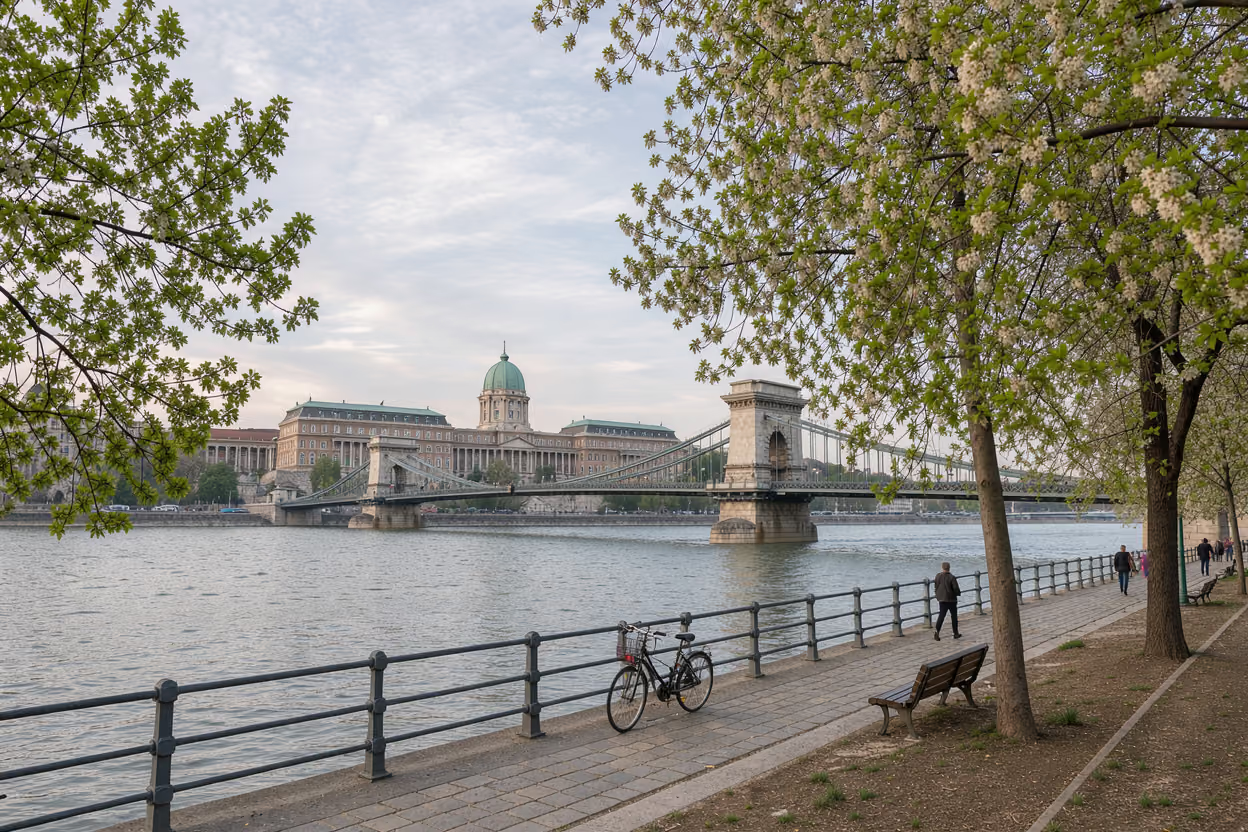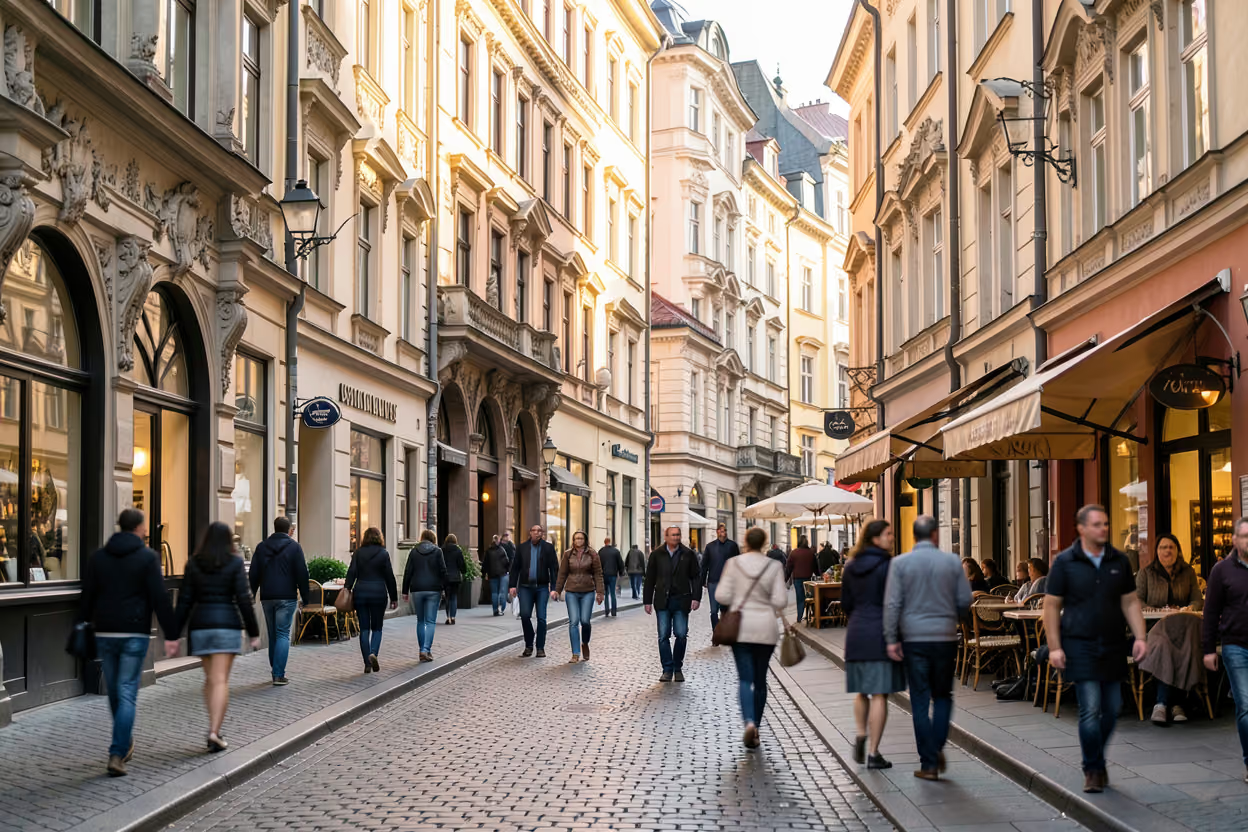
The nearly two-kilometre pedestrian route runs through central Pest, between Vörösmarty Square and Fővám Square. Walk the full length to see how its character changes, then decide whether you want a snack or would rather sit down for a proper meal in another neighborhood.
Quick answer
- Walking along Váci Street is free, and there are no fixed opening hours for the street itself.
- Allow about 30–60 minutes for a relaxed walk; shopping and food stops add time.
- Kossuth Lajos Street divides a polished, shopping-focused northern stretch from a more mixed southern one.
- “Don’t eat at Váci Street” is useful caution, not proof that every restaurant is a tourist trap.
- Read the full menu, check service charges and cover charges, and pay in HUF. If a card terminal offers to convert the bill to dollars, decline the conversion.
Váci Street Budapest: What the Walk Is Like
A central Pest promenade from Vörösmarty Square to Fővám Square
Váci utca is one of central Pest’s best-known pedestrian streets, running nearly two kilometres from Vörösmarty Square in the north to Fővám Square in the south. It is primarily in District V and lined with shops, cafés, restaurants, and souvenir stores. The street is an active pedestrian area in 2026, not a ticketed attraction or a place you need to book.
You can walk it at any time, but individual businesses keep their own hours. That makes Váci Street easy to add to a day in central Budapest: start at either end, stroll through, and continue to nearby sights rather than planning an entire day around it.
Two sections with different moods
Kossuth Lajos Street cuts across Váci utca and marks a noticeable change in atmosphere.
- North of Kossuth Lajos Street: The stretch toward Vörösmarty Square is more polished and shopping-focused, with international brands, cafés, and busy foot traffic. It is the part most visitors picture when they hear about Váci Street.
- South of Kossuth Lajos Street: The street becomes more varied as it heads toward Fővám Square. The Central Market Hall is close to the southern end, making this a useful direction if you want to combine a walk with a market visit.
If you have only a short time, walk south from Vörösmarty Square and continue as far as your interest holds. If you have longer, go all the way to Fővám Square; the change in character is part of the point.
What it is good for—and what it is not
Váci Street works well for a central walk, browsing shops, taking in the street scene, and people-watching over a coffee. It is also an easy route to pair with nearby squares and the Central Market Hall.
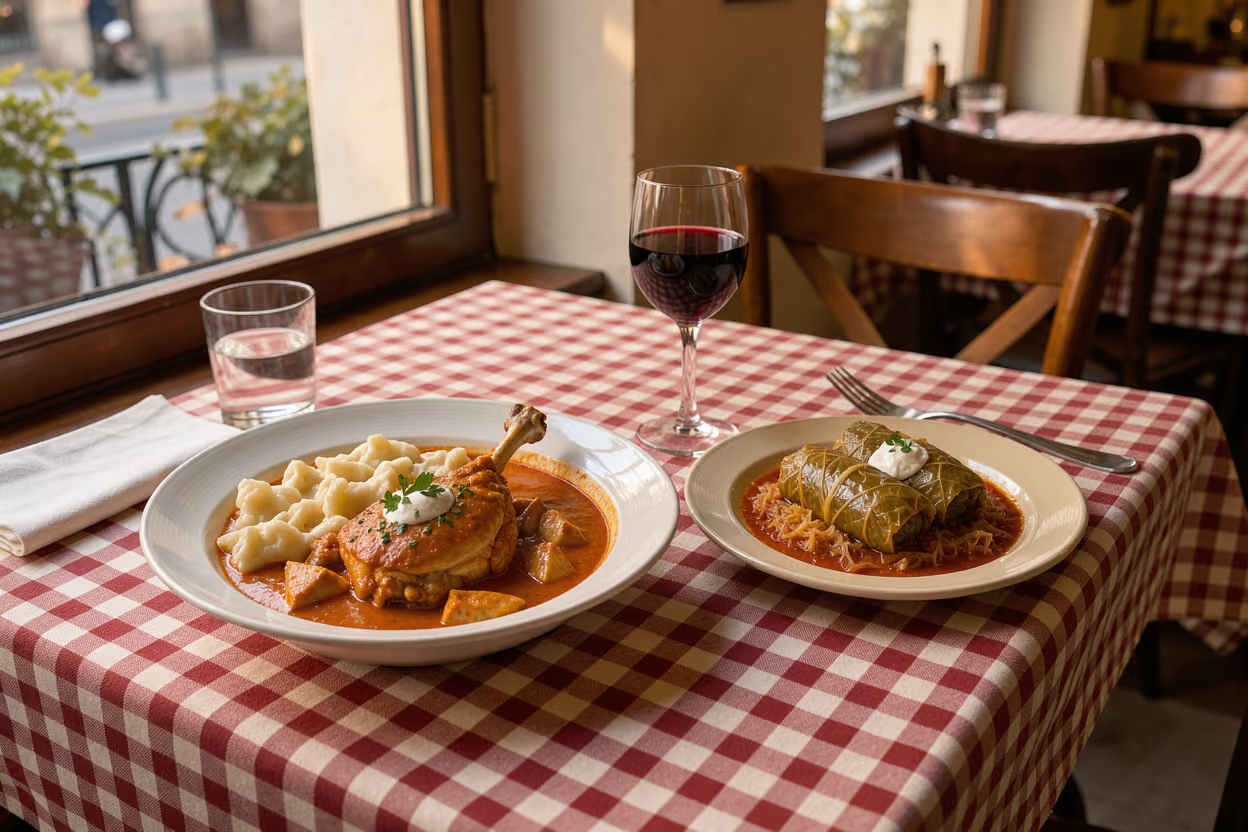
It is not generally Budapest’s strongest choice for a good-value traditional Hungarian meal. The busiest part is heavily geared toward visitors, and a prominent location does not guarantee an especially good menu or price. Treat the street as a promenade first and a place to eat only if a particular venue stands up to a quick check.
Váci Street Budapest Restaurants: Why Locals Say to Eat Elsewhere
Why the advice exists
The warning about dining on Váci Street comes from a familiar tourist-area trade-off: prices can be high compared with the quality or the kind of Hungarian food a visitor expects. The most visible restaurant is not automatically the best one, and a menu aimed at passing foot traffic may not be the experience you came to Budapest for.
That said, a high price in a busy central location is not, by itself, evidence of an illegal charge or a dishonest restaurant. The useful question is whether the menu, portions, and total cost seem fair to you before you order.
Should you really avoid every Váci Street restaurant?
No. The idea that locals universally say never to eat on Váci Street is too sweeping to verify. Many repeat visitors and locals advise caution because the area is tourist-oriented, but that is a reason to be selective—not a reason to assume every business is bad.
Before sitting down, compare a few written menus. Look beyond the headline price: check portion sizes, the currency, whether a service charge is included, and whether there is a cover charge. Recent independent reviews can help, especially if they discuss food and value rather than just location. If a promoter is urging you inside, ask to see the full menu and terms first.
A snack stop is different from a full meal
A quick snack can make sense even if you decide to have dinner elsewhere. Official Budapest tourism materials list chimney cake and lángos businesses at Váci utca 31, including Molnár’s Kürtőskalács and Molnár’s Lángos. These are convenient options to look into while walking, not a guarantee of a particular price, opening time, or full traditional meal.
Check the current details directly before making a special trip. If the place is closed or the menu does not appeal, keep walking; there are plenty of other places to eat around the city.
How to Spot Tourist Traps in Budapest on Váci Street
Read the full menu before you sit down
The easiest way to avoid an unpleasant surprise is to make your decision before ordering. Look for a written menu outside, and check:
- Prices and currency: Confirm that prices are shown clearly and in HUF.
- Portions: A low price may not mean a filling meal; a large-looking menu does not tell you the serving size.
- Service charge: Check whether one is added to the bill.
- Cover charge: Look for any separate charge for sitting down or for bread.
- Promotions: If someone offers a special deal, ask to see its price and conditions in writing.
If anything is unclear, ask before ordering. It is much easier to decide to leave before a meal than to dispute an unexpected charge afterward.
Check the bill and payment currency
When the bill arrives, review the itemized list and make sure the food and drinks you ordered are there. If something does not look right, ask about it before paying.
Hungary’s currency is the forint, abbreviated HUF. Paying by card in HUF is usually the simplest option. If the card terminal offers to charge you in US dollars, decline that conversion—also called dynamic currency conversion—and let your bank handle the exchange. The displayed conversion rate may be less favorable.
Use recent, independent reviews
A restaurant’s location on Váci Street tells you where it is, not whether it suits your budget or taste. Read a handful of recent independent reviews and compare them with the menu you can see in person. Pay attention to comments about food quality, portion sizes, service, and the final bill.
Avoid relying on a street promoter’s recommendation alone. And don’t treat a tourist-area price as proof of a scam: the practical test is whether the terms are clear and the experience is worth the amount you are being asked to pay.
Costs, Opening Hours, and the Best Time to Visit
The walk is free; food and shopping costs vary
There is no admission charge to walk along Váci Street. What you spend is up to you: shops, cafés, snacks, and restaurants set their own prices, and there is no reliable single price estimate that applies across the street. Check the current menu rather than budgeting around a general figure.
The same goes for shopping. Váci utca is a convenient place to browse, but compare prices elsewhere if you are buying something beyond a small souvenir. A central address is not a reason to assume a product is a good deal.
When to go for a calmer stroll
For a quieter walk, go earlier in the day. Evenings and peak summer periods are busier, and summer or major holidays can bring heavier pedestrian traffic and more pressure on restaurant capacity. If your priority is a relaxed look around, avoid choosing the busiest dinner period.
Winter is still a reasonable time for a brief central walk, though daylight is shorter and the weather may make outdoor seating less appealing. Around Christmas, decorations and shopping crowds can change the feel of the street considerably; individual businesses may also have reduced holiday hours.
Check individual business hours
Váci Street is an open-access public street, with no fixed opening hours. Shops, cafés, restaurants, and attractions each set their own schedules, so don’t assume a particular business will be open just because the street is busy.
The Central Market Hall sits near the southern end, but its current 2026 hours are not confirmed here. Check the market’s own information before making it the centerpiece of your visit.
How to Get to Váci Street and Plan the Walk
Start at Vörösmarty Square and walk south
For a straightforward route, begin at Vörösmarty Square and walk south along the pedestrian stretch. Notice how the street changes around Kossuth Lajos Street, then continue toward Fővám Square if you want to finish near the Central Market Hall.
Allow roughly 30–60 minutes for a relaxed walk without a long meal or extended shopping stops. Add time for photographs, browsing, or a snack. If you are short on time, the northern section gives you the most concentrated shopping-street feel; the full route gives a better sense of the street as a whole.
Nearby public transport options
For the northern end, take metro M1 to Vörösmarty tér. Deák Ferenc tér is also a short walk away. For the southern stretch, metro M3 serves Ferenciek tere and Kálvin tér, while metro M4 stops at Fővám tér. Tram 2 runs along the Danube-side area near Fővám Square.
BudapestGO and BKK machines sell tickets and passes; check one of them for current fares. Paper single tickets must be validated when boarding. Inspectors can fine passengers with unvalidated tickets, so do not assume that holding an unused ticket is enough.
Where to Eat Instead of Choosing at Random
Continue toward Fővám Square and the Great Market Hall
At the southern end of Váci Street, the Central Market Hall is a practical stop for browsing Hungarian food products and market stalls. It is useful as a place to look around and get a feel for local ingredients, but check its current opening hours before building your schedule around it. Market stalls and a sit-down restaurant are different kinds of meal, so choose based on what you actually want.
Compare restaurants beyond the main tourist strip
If you want a fuller meal, look beyond the busiest section of Váci Street rather than picking the first inviting menu you see. The Jewish Quarter and District VII offer a broader range of restaurants to compare. Use current independent reviews and a written menu to decide; a recommendation from a reputable local or tourism guide is more useful than a restaurant’s most visible address.
This does not mean you have to cross the city for dinner. It simply gives you more options than relying on a single tourist-heavy street, especially if you are looking for a meal that feels distinctly Hungarian and offers good value.
Choose a quick snack if you are staying on Váci Street
If you want something small while walking, the tourism-listed chimney cake and lángos businesses at Váci utca 31 are possible stops. Check current hours and prices directly, and treat them as snack options rather than a promise of a complete meal or a particular bargain.
Frequently asked questions
Is Váci Street in Budapest worth visiting?
Yes, if you want a central, free pedestrian walk for shopping, architecture, and people-watching. It is nearly two kilometres long, and a relaxed stroll takes about 30–60 minutes.
Why do people say, “don’t eat at Váci Street”?
The street is highly tourist-oriented, so some restaurants may not offer the value or traditional Hungarian food visitors expect. Treat the advice as a reason to compare menus and reviews, not as a rule that every restaurant is bad.
Is Váci Street a tourist trap in Budapest?
It is a popular tourist shopping street, but that does not make every business a trap. Check written prices, portion sizes, service charges, and recent independent reviews before ordering.
How long should I spend on Váci Street?
Allow roughly 30–60 minutes for a relaxed walk. Add time if you plan to shop, take photographs, or stop for food.
Does it cost anything to walk along Váci Street?
No. The pedestrian street is free to visit; shopping, food, and drinks cost extra, and prices vary by business.
Where does Váci Street start and end, and how do I get there?
It runs between Vörösmarty Square and Fővám Square in central Pest. Metro options include M1 for Vörösmarty tér, M3 for Ferenciek tere or Kálvin tér, and M4 for Fővám tér.
Váci Street Budapest is worth seeing as a central promenade, especially if you walk the full route and notice the shift around Kossuth Lajos Street. For a meal, compare menus and recent reviews—or head beyond the main tourist strip—instead of assuming the most visible restaurant is your best choice.
Related guides
- Buda Castle Visitor Guide
- Budapest Christmas Market 2026
- Budapest Parliament Tickets
- Budapest Thermal Baths
- Things to Do in Budapest
- Budapest 3 Day Itinerary
- Landmarks in Budapest
- Top attractions in Budapest