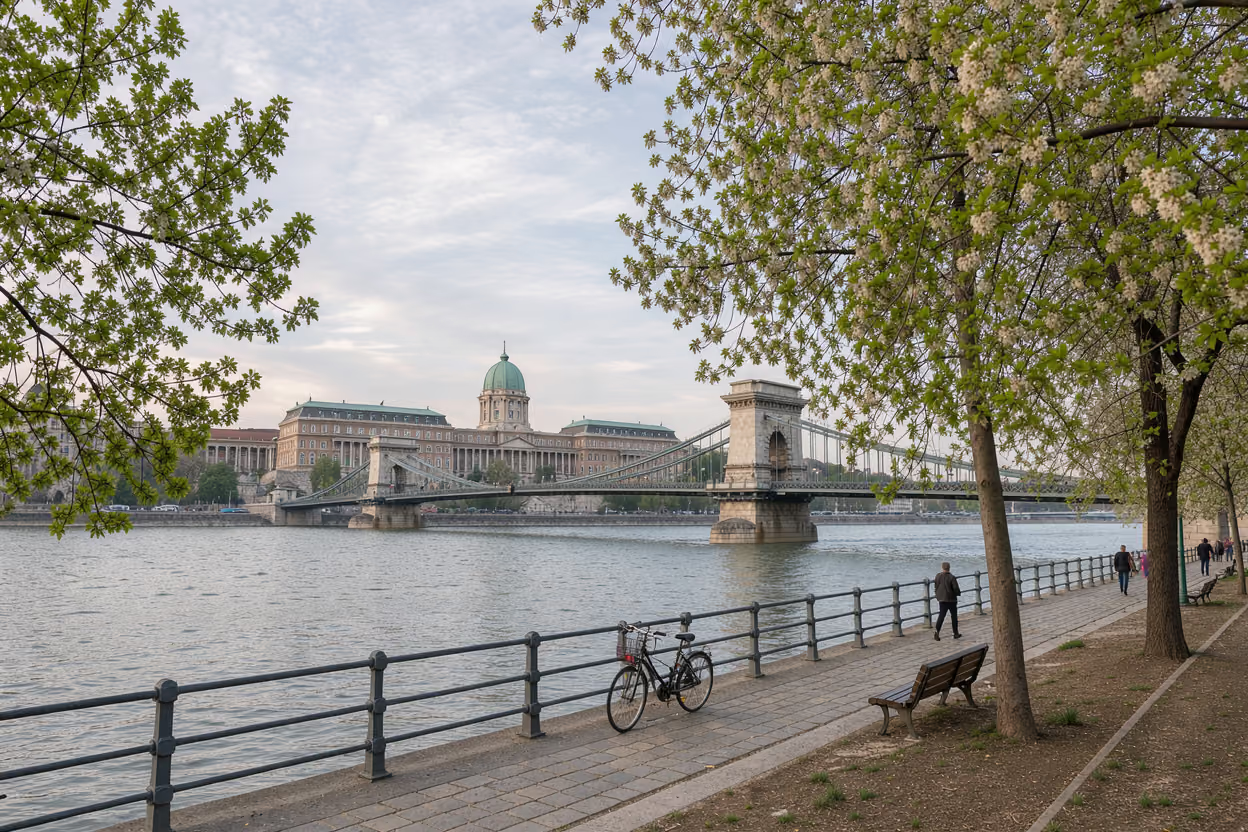
Two days can work if you focus on the highlights, but it will feel brisk. Six nights is not too much if you want day trips, museums, baths, nightlife, or simply a less scheduled trip; it is more time than you need for the central sights alone.
Quick answer
- Plan 3 full sightseeing days for the main sights, a thermal bath, and an evening by the Danube.
- Choose 4 full days for a more relaxed first visit, extra museum or neighborhood time, or a slower start after a long flight.
- Two days is enough for a fast highlights trip, but expect to leave some things for next time.
- Count arrival and departure days separately: transfers, check-in, and airport time can swallow much of either day.
- The dedicated 100E airport bus ticket is listed at 2,200 HUF; ordinary local tickets are not accepted. Check the current fare before travel.
How many days in Budapest do you need for a first visit?
The short answer: plan 3 to 4 full days
If you want a clear recommendation, spend three full days in Budapest if your priority is seeing the main sights. Use a fourth day if you prefer fewer checklist-style days or want time for a museum, a second neighborhood, or a slower bath visit.
Budapest is generous with its main sights, but the city is not a single compact old town. The Danube divides it into Buda and Pest, and although the two sides are connected by bridges and public transport, crossing back and forth repeatedly wastes time. Grouping nearby places makes a big difference.
A first visit usually centers on the Buda Castle District; Parliament and the Danube waterfront; St. Stephen’s Basilica; the Jewish Quarter; and City Park. Three days is enough to see a good portion of that list. Four lets you enjoy it without rushing from one timed admission to the next.
Count full sightseeing days, not just calendar days
A trip listed as “three days in Budapest” may give you only one or two genuinely useful days. A morning arrival can leave time for a walk and dinner, but an afternoon arrival often means little more than checking in. The same applies on departure day, especially if you need to reach the airport early.
For travelers coming from the United States, jet lag is another reason to avoid packing the first morning. You may feel ready to go and then run out of energy by lunchtime. Leave a flexible half-day for sleep, poor weather, shopping, or an attraction that takes longer than expected.
Why Budapest works well as a first European city break
The city is easy to divide into practical sightseeing areas. Spend a day on Castle Hill and the Buda side, another around central Pest and the river, then use a third for City Park, a bath, a museum, or a neighborhood walk. That simple structure keeps most days focused and limits unnecessary transit.
Many repeat visitors like Budapest because you can combine major architecture, café stops, river views, and a thermal bath without needing a tightly scheduled tour every day. The trade-off: distances can look shorter on a map than they feel after a full day of walking. Wear comfortable shoes, particularly on Castle Hill and along the riverfront.
Choose a Budapest itinerary: 2, 3, or 4 full days
| Time available | Best for | The honest trade-off |
|---|---|---|
| 2 full days | A fast weekend focused on landmark sights | Little time for museums, long meals, or wandering |
| 3 full days | Most first-time visitors | A balanced visit, but you will still need to choose |
| 4 full days | A comfortable first visit | More time for baths, museums, and slower days |
| 5–7 nights | Day trips and a deliberately relaxed pace | More time than needed for only the central highlights |
Two days: a fast-paced highlights visit
Two days in Budapest is doable, but plan it as a highlights trip rather than a complete introduction to the city. On one day, focus on the Buda Castle District, including Matthias Church and the nearby viewpoints. On the other, cover central Pest and the Danube landmarks, then choose one extra priority: the Jewish Quarter, City Park, or a thermal bath.
Do not try to fit all three extras into the second day. A bath visit takes several hours if you want it to feel worthwhile, and museums and historic interiors can take longer than their map pins suggest. Budapest tourism provides a dedicated 48-hour route if you want a ready-made framework, but you will still need to choose what matters most to you.
3 days in Budapest: the best compromise for many first-timers
For many visitors, 3 days in Budapest is the sweet spot. A practical plan looks like this:
- Day 1: Buda. Explore the Castle District and nearby sights. If you arrive tired, keep the day simple and save the longer walks for later.
- Day 2: Central Pest and the Danube. See Parliament and the riverfront, then continue toward St. Stephen’s Basilica and central Pest. Add the Jewish Quarter if you have the energy.
- Day 3: Choose your pace. Pair City Park with Heroes’ Square and Széchenyi Thermal Bath, or use the day for a museum and a neighborhood-focused walk.
Keep one evening for the Danube waterfront. A cruise is a good option if you want to see the illuminated bridges, Parliament, and Castle Hill from the water, but do not build your whole evening around an assumed departure time. Cruise schedules vary by operator and season, so reserve a specific departure if it is a priority.
4 days in Budapest: a more comfortable first visit
With 4 days in Budapest, keep the first three days for the main areas and use the fourth to slow down. You could spend a longer stretch at a bath, visit another museum, walk Margaret Island, explore the Buda Hills, or take a half-day excursion.
Four full days is especially sensible after a long flight from the United States. It gives you room to sleep in one morning and to leave an attraction early if you have had enough. You do not need to fill every hour to make the extra day worthwhile; a long lunch and an unhurried walk can be a better use of it than squeezing in another distant sight.
Is 6 nights in Budapest too much?
When six nights makes sense
No—not if you have things you genuinely want to do beyond the central sights. Six nights can suit travelers planning day trips, more than one bath visit, several museums, nightlife, food experiences, or a slower pace. It also gives you room to change plans when the weather is poor or you find a neighborhood you want to spend more time in.
Possible day trips include Szentendre, the Danube Bend, Gödöllő, and Lake Balaton. These are not interchangeable quick add-ons: travel time and services vary, and some destinations work better as a full-day outing than a half-day one. Check current transport or tour schedules before you reserve a day for one.
When six nights may feel long
If your entire wish list is Parliament, Castle Hill, the Basilica, the Jewish Quarter, and one bath, three to four full days is usually enough. A longer stay may feel slow if you expect a new major attraction to fill every day.
That is not necessarily a problem. Use a spare day for a flexible neighborhood visit, a second bath, or rest instead of crossing the city for a sight you are only mildly interested in. Six nights also do not always mean six usable sightseeing days: arrival and departure logistics still count.
Plan transport, tickets, and costs around your sightseeing days
Getting from Budapest Airport to the city
The 100E airport bus runs between the airport and the city and requires a dedicated airport-shuttle ticket. Official Budapest tourism information lists that ticket at 2,200 HUF; ordinary local tickets are not accepted. Treat that as a time-bound fare, not a promise that the price will remain the same for your travel date.
An official airport taxi or a pre-booked transfer is another option, especially if you are arriving late, traveling with children, or carrying a lot of luggage. Use the official airport taxi process or a reputable service, and confirm how the fare is calculated before you set off.
Use public transport without losing sightseeing time
Budapest tickets and passes are available in the BudapestGO app and at BKK ticket machines. Check the BKK journey planner when you need a route; it is more useful than guessing which line is fastest from a map.
One important rule: paper single tickets must be validated when you board. Inspectors check tickets, and passengers with unvalidated tickets can be fined. If you have a pass or a mobile ticket, read the instructions for that product rather than assuming every ticket works the same way.
Compare a travel card with individual tickets
A Budapest Card may be worthwhile if its transport and included benefits line up with your actual plans. It is not automatically the cheaper choice. A visitor who walks most places and pays for only a few attractions may do better with individual tickets; someone using transport frequently and visiting included sights may get more from the card.
Before buying, compare the current Budapest Card price and inclusions with the admissions and transport you expect to use. The same goes for the Budapest Card 72H PLUS: check what it includes on your dates rather than buying it simply because it is called a “plus” card.
Budget in forints and verify admission prices
The local currency is the Hungarian forint (HUF). Paying by card in HUF is usually the simplest choice; if a card terminal offers to charge you in U.S. dollars instead, decline dynamic currency conversion.
Baths, museums, cruises, and transport passes have different prices and ticket conditions, which can change. Check the official operator’s current price and terms before you book, particularly for timed-entry visits.
Time your days well and book the activities that matter
Group sights by area to avoid backtracking
Keep Buda Castle District and Matthias Church together. On a central Pest day, pair Parliament and the Danube memorial with nearby sights rather than crossing the river for a single stop. Group City Park with Heroes’ Square and Széchenyi Thermal Bath.
The M1 metro serves City Park stops including Széchenyi fürdő and Hősök tere. Check the journey planner for the best route on the day, especially if you are traveling at a busy time or changing plans.
Reserve timed-entry visits and check opening hours
Parliament, museums, churches, the Great Synagogue, baths, and cruises all have their own schedules and entry rules. Check the official venue information for opening hours and last entry before you build a day around a specific visit. Book timed-entry attractions in advance when the operator requires or recommends it—especially Parliament and popular baths.
Fit a bath and Danube experience into the right part of the day
A thermal bath is better as the main activity for a late afternoon or a lower-energy day than as a quick stop between two timed attractions. Give yourself enough time to change, get oriented, and enjoy the visit without watching the clock.
Set aside an evening for the Danube waterfront or a cruise. If you are happy with a walk, the river is still worthwhile; you do not need to buy a ticket to enjoy the city’s evening views. If a cruise is important, choose and reserve a departure after checking the operator’s schedule.
Adjust for season and weather
Summer brings long daylight but can also mean busier attractions and baths. Winter has shorter daylight, so put outdoor sightseeing earlier in the day and keep museums, cafés, or a bath as useful later options. Outdoor services and cruises can be affected by season or weather.
Christmas and New Year can bring changed opening hours, closures, and special schedules. Confirm plans directly with the venues for those dates rather than assuming normal hours.
Avoid common itinerary mistakes and choose the right alternative
Mistakes that make a short stay feel rushed
The most common planning error is treating three calendar days as three full days. Arrival, check-in, and departure can remove a large part of the time you thought you had.
Another is trying to combine Buda Castle, Parliament, City Park, a thermal bath, and several museums in one day. Choose one main geographic cluster and a manageable number of stops. Budapest rewards wandering, but only if you leave some space for it.
Avoid transport and money pitfalls
Do not board the 100E with an ordinary local ticket; it requires its dedicated airport-shuttle ticket. Validate paper single tickets when you board, and check the final amount and any commission if exchanging cash. Use reputable exchange services or ATMs rather than choosing a kiosk based only on its location.
Choose between a shorter stay, extra days, and a travel card
The short version: two days is a fast weekend, three is a strong highlights visit, and four is the more comfortable choice. Five to seven nights makes sense if you are adding day trips, more baths, nightlife, or unhurried time. For transport and admissions, compare the current Budapest Card 72H PLUS inclusions and price with individual tickets; choose based on your planned visits, not on the assumption that a pass always saves money.
Choose thermal baths that are operating
Gellért Thermal Bath is closed for a full renovation and is expected to remain closed until 2028. Do not plan a visit there. Alternatives to consider include Rudas, Széchenyi, Lukács, Veli Bej, and Király; check each bath’s current facilities, admission rules, and availability before choosing.
Check entry requirements before traveling from the United States
Before departure, verify passport-validity rules, Schengen stay limits, and any entry-authorization requirements that apply to your travel dates. Use official Hungarian, EU, and U.S. government sources; entry rules can change.
Frequently asked questions
How many days in Budapest do you need for a first visit?
Plan 3 to 4 full days. Three covers the main Buda and Pest areas with time for a bath or an evening Danube experience; four allows a more relaxed pace and room for an extra museum or neighborhood.
Is 2 or 3 days enough for Budapest?
Two days is enough for the major landmarks if you move quickly and accept that you will miss some museums and slower neighborhood time. Three full days is a better compromise for most first-time visitors.
Is 6 nights in Budapest too much?
Not if you want day trips, museums, baths, nightlife, food experiences, or a slower pace. If you are interested only in the central highlights, three to four full days is usually enough.
Should I spend 3 days or 4 days in Budapest?
Choose three for the main sights and a focused itinerary. Choose four if you want time for museums, neighborhoods, baths, or a gentler start after a long flight.
Do arrival and departure days count as full days in Budapest?
Usually not. Airport transfers, check-in, and departure logistics can cut into sightseeing time, so count the full days you can actually explore.
Can I use a regular transit ticket on Budapest’s 100E airport bus?
No. The 100E requires its dedicated airport-shuttle ticket, listed at 2,200 HUF in official tourism information. Check the current fare before travel.
Is Gellért Thermal Bath open for a visit?
No. Gellért is closed for a full renovation and is expected to remain closed until 2028. Consider Rudas, Széchenyi, Lukács, Veli Bej, or Király instead, and confirm current visitor information before you go.
For most first-time visitors asking how many days in Budapest, three full days is a strong starting point and four is the more comfortable choice. Add nights for a specific reason—day trips, baths, museums, or a slower pace—and count the sightseeing days you actually have, not just the nights on your booking.
Related guides
- Budapest 3 Day Itinerary
- Budapest 4 Day Itinerary
- Best Day Trips from Budapest by Train in 2026
- Things to Do in Budapest
- Buda Castle tickets and tours
- St. Stephen’s Basilica tickets
- Hungarian Parliament tickets and tours
- Budapest month by month