In 2026, a standard day ticket with a locker costs around 13,200–15,800 HUF (about $35–$42, depending on the date and exchange rate). If that sounds steep for a busy bath, consider Rudas for historic atmosphere and rooftop views, or Lukács for a more local-feeling visit.
Quick answer
- Széchenyi is open daily in 2026. Standard hours are 07:00–20:00 Monday–Thursday, 07:00–22:00 Friday, and 08:00–20:00 Saturday–Sunday.
- A day ticket with a locker costs 13,200 HUF Monday–Thursday, 14,800 HUF Friday–Sunday, and 15,800 HUF on listed holidays and peak dates.
- Weekday opening time is usually the best bet for fewer people; weekends and Friday evenings are typically busier.
- Winter is especially atmospheric outdoors, but Széchenyi suits travelers after the classic, photogenic Budapest bath experience more than those seeking quiet.
- Rudas is a strong alternative for historic character and views. Gellért is closed for renovation and expected to remain closed until 2028.
What to Expect at Széchenyi Baths in Budapest
A landmark bath complex in City Park
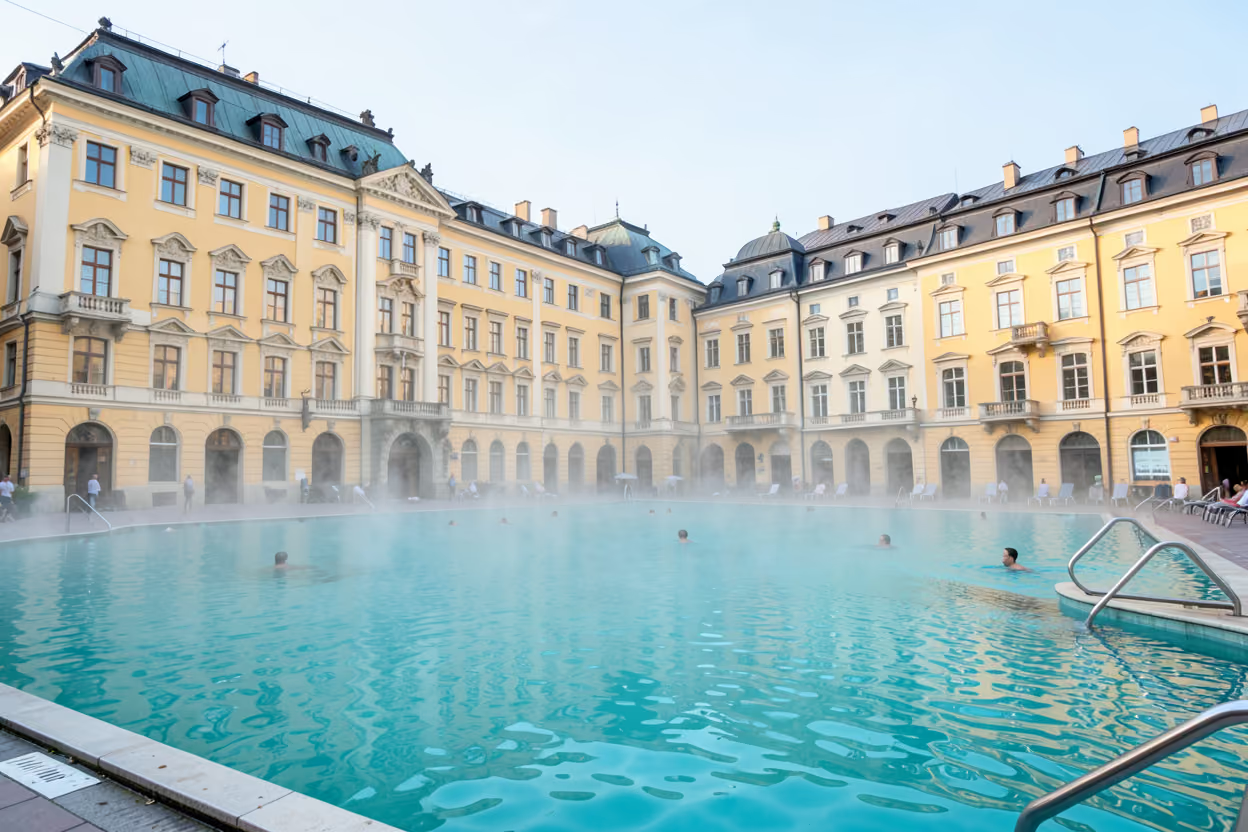
Széchenyi is Budapest’s largest and most iconic bath complex. It combines outdoor thermal pools with indoor pools, saunas, steam rooms, and hot-air chambers, all in a grand yellow building in City Park. The address is Állatkerti körút 11, 1146 Budapest, near Heroes’ Square.
The signature experience is bathing outside, with the ornate building around you and steam rising off the water in cool weather. The outdoor pools are the reason many first-time visitors choose Széchenyi over other Budapest thermal baths. But the complex is large, and it takes time to get oriented; don’t plan on dropping in for a quick dip and leaving ten minutes later.
What the standard day ticket includes
A standard day ticket with a locker gives you access until closing, subject to the terms of the ticket you select. A locker is for storing your belongings; it is not a private changing cabin. Choose a cabin ticket if you want private changing space or extra room to organize your things.
Most visitors will be fine with a locker. The extra cost of a cabin is worth considering if privacy matters to you, but it is not essential for a straightforward bath visit.
Széchenyi Baths Tickets and Prices in 2026
Standard tickets, cabins, and Fast Track
These are the 2026 prices for a standard day ticket with a locker. Holiday and peak-date prices apply to specific dates, so don’t assume every weekday is in the lowest tier.
| Ticket | Monday–Thursday | Friday–Sunday | Holidays and peak dates |
|---|---|---|---|
| Standard day ticket with locker | 13,200 HUF | 14,800 HUF | 15,800 HUF |
| Fast Track with locker | 15,200 HUF | 16,800 HUF | 17,800 HUF |
Fast Track is available online only. It may be useful on a busy date, but don’t pay extra by default: an early weekday arrival is often the better way to avoid the worst of the queues.
Online daily tickets with cabin use are approximately €42–€50, while Fast Track with a cabin is approximately €48–€56. Those euro prices vary by date and exchange rate. A cabin costs more than a locker ticket, so check the product details before you pay.
How to save and when to book
The in-person Good Morning Budapest ticket costs 10,500 HUF Monday–Thursday or 11,800 HUF on Friday. You must both buy the ticket and enter by 09:00. It is not available on weekends or holidays, and arriving after the cutoff can invalidate the discounted entry.
Official tickets can be booked up to 180 days ahead. Online tickets get priority if the bath reaches capacity; limited tickets may still be sold at the entrance, but availability is not guaranteed. Book ahead for weekends, holidays, and the winter high season, when an on-site gamble is not worth the risk.
Use the official Széchenyi ticket site and compare the price for your exact date. The entrance opposite the circus accepts bank-card payment only for on-site tickets, according to the bath’s 2026 price information.
Budget in forints and check the product details
For U.S. travelers, think in Hungarian forints (HUF), not euros. Paying by card in HUF is usually the better choice; decline dynamic currency conversion if a terminal offers to charge you in dollars or euros.
Before confirming, make sure you have selected a locker or cabin ticket as intended. Fast Track is a separate product, and a locker does not mean private changing space.
Are Széchenyi Baths Worth It?
When the experience earns its price
For a first visit to Budapest, Széchenyi is a good choice if you want the classic thermal-bath experience: a wide range of pools, a grand setting, and the famous outdoor bathing. Winter is when the contrast between warm water and cold air is most striking, and it’s a very different experience from simply seeing the building from outside.
If that’s the image you have in mind when you think of Budapest baths, the ticket price can make sense. Arrive early on a weekday and give yourself time to enjoy more than just the main outdoor pool.
When crowds can make it feel overrated
The downside is real: Széchenyi is popular, and the atmosphere can feel tourist-oriented, especially at busy times. If you want quiet, local character, or the lowest price, it may not be your best-value option.
Many repeat visitors prefer Rudas because it has a more intimate historic setting and rooftop views. That doesn’t make Széchenyi a bad choice; it reflects different priorities. Rudas is stronger for atmosphere and views, while Széchenyi wins for its extensive pools and classic outdoor-bath experience.
How much time to allow
Allow at least two to three hours for bathing, changing, and exploring the complex. Treating Széchenyi as a quick photo stop is a poor use of the ticket price, while trying to see every pool in a rush can make the visit feel more like a chore than a break.
Choose based on what matters most: the iconic setting and outdoor pools, or a quieter, smaller, more historic-feeling bath.
Best Time to Visit: Winter, Weekdays, and Night Options
Winter visits and peak-season dates
Budapest thermal baths in winter have a particular appeal: the outdoor pools stay hot while the air is cold. Bring warm clothes for the walk back to the metro, and expect more demand around Christmas and New Year.
The official site lists a peak period from December 18, 2026, through January 6, 2027, with an 08:00 opening. Holiday schedules can differ from the standard timetable, so check your date before setting out.
Opening hours and quieter times
The standard 2026 hours are:
- Monday–Thursday: 07:00–20:00
- Friday: 07:00–22:00
- Saturday–Sunday: 08:00–20:00
Pools, saunas, and hot-air chambers generally close 20 minutes before the building. That means the facilities close at 19:40 on days when the bath closes at 20:00, and at 21:40 on Fridays.
Weekday opening time is usually the calmest slot. Weekends and Friday evenings tend to be busiest. Holiday hours may differ: Széchenyi closes at 16:00 on December 8, 2026, and at 20:00 on December 25, 2026, and January 1, 2027. Confirm the hours for your exact date through the official opening-hours page.
Is Széchenyi open at night? Understanding Sparty
Friday is the regular late-opening day, with the bath open until 22:00 under the standard schedule. That’s useful if you want a later soak, but don’t confuse it with a party night.
Sparty is a separate, ticketed nighttime bath-party event with loud music and visual effects. It is not a quiet spa session; go for the nightlife experience, not a relaxing soak. Check the official event information for dates and tickets.
How to Get to Széchenyi Baths and Plan Your Visit
Getting there by public transport
Take the M1 Millennium Underground to Széchenyi fürdő station. Trolleybuses also serve the City Park area. From the station, allow extra walking time and follow the signs to the entrance opposite the circus.
What to bring and what to do on arrival
Pack a swimsuit, towel, flip-flops, and a waterproof bag for small valuables. A reusable water bottle is optional. Follow staff directions for changing rooms and locker or cabin allocation, and keep your wristband or access token secure.
Before entering a pool, rinse off and follow the posted hygiene and pool rules. Put valuables in your assigned locker or cabin rather than leaving them unattended.
Leave time to change and follow pool guidance
Don’t plan to start your shower and change at closing time. The pools, saunas, and hot-air chambers generally close 20 minutes before the building, so leave enough time to get out, shower, and collect your things.
Pool temperatures and rules vary. Follow the signs and avoid staying in very hot water for long periods. If you have heart or circulation concerns, are pregnant, or have another medical concern, get medical advice before using very hot thermal pools.
Common Széchenyi Baths Mistakes to Avoid
Avoid the wrong ticket or an unofficial reseller
Buy through the official bath website or its ticket portal. Unofficial resellers may charge more, have unclear cancellation terms, or sell products that don’t match what you expect. Check whether your booking includes a locker or cabin, and remember that online euro prices can change with exchange rates and date-based pricing.
Do not miss the Good Morning entry cutoff
For the Good Morning Budapest ticket, both purchase and entry must be completed by 09:00. Arriving late can invalidate the discounted entry, so don’t plan a leisurely breakfast before using it.
Check date-specific hours and capacity
Don’t rely on the standard schedule for a holiday or peak-season visit. Book ahead for weekends and winter dates; if online tickets are sold out, a few on-site tickets may still be available, but they are not guaranteed.
Set realistic expectations for Sparty and a late arrival
Sparty is a party event with a separate ticket, not a standard quiet bath visit. And while a regular day ticket is generally valid until closing, don’t assume every product has identical terms or that arriving late gives you a shorter ticket. Check your selection and leave enough time to use the facilities before they close.
Alternatives to Széchenyi: Rudas, Lukács, and Others
Choose Rudas for historic atmosphere and views
Rudas is the better fit if you want a smaller historic Ottoman setting, rooftop views, and a more adult-oriented experience. Its opening rules and pool access can vary by date and gender schedule, so check the arrangements before you go.
Choose Lukács or Veli Bej for a less iconic experience
Lukács feels more local and less focused on the grand, photogenic setting. Choose it if you’d rather have a calmer bath visit than the full Széchenyi spectacle. Veli Bej is another option to compare; confirm its current access details before making plans.
Gellért is closed; consider Dandár for value
Gellért Thermal Bath is closed for full renovation and is expected to remain closed until 2028. Don’t build a 2026 itinerary around it; consider Rudas, Széchenyi, Lukács, Veli Bej, or Király instead.
Dandár is a more modest, often cheaper choice if value matters more than grand architecture or the City Park setting.
Frequently asked questions
Is Széchenyi Thermal Bath worth it?
Yes, if you want Budapest’s iconic, photogenic bath experience and don’t mind crowds. It is less compelling if you’re after quiet, local atmosphere or the lowest price; in that case, compare Lukács or Rudas.
How much do Széchenyi Baths tickets cost in 2026?
A standard day ticket with a locker costs 13,200 HUF Monday–Thursday, 14,800 HUF Friday–Sunday, and 15,800 HUF on listed holidays and peak dates. Check the official site for your date and ticket type, since prices and categories vary.
Are Budapest thermal baths worth visiting in winter?
Yes. Széchenyi’s hot outdoor pools are especially atmospheric in cold air, though demand rises around Christmas and New Year. Book ahead and bring warm clothes for the walk back to the metro.
Is Széchenyi open at night, and what is Sparty?
Under the standard schedule, Friday is open until 22:00. Sparty is a separate ticketed nighttime party with music and visual effects, not a quiet regular bath visit.
Is Rudas better than Széchenyi?
Rudas is the stronger pick for historic atmosphere and views; Széchenyi is better for extensive pools and the famous outdoor-bathing experience. Neither is universally better, but if crowds are your main concern, Rudas is worth comparing.
Is Gellért Thermal Bath open in 2026?
No. Gellért is closed for full renovation and is expected to remain closed until 2028. Consider Rudas, Széchenyi, Lukács, Veli Bej, or Király instead.
If Széchenyi’s outdoor pools and City Park setting are what you came to Budapest for, the 2026 price is reasonable—just go early on a weekday if possible. If you’d rather have a smaller, more atmospheric bath, compare Rudas or Lukács, and check the official site for date-specific tickets and hours before booking.
Related guides
- Budapest Thermal Baths
- Budapest Thermal Baths
- Gellért Baths
- Rudas Baths Guide
- Things to Do in Budapest
- Budapest 3 Day Itinerary
- Top attractions in Budapest