Architecture: the history of Hungary’s Parliament
Origins and development
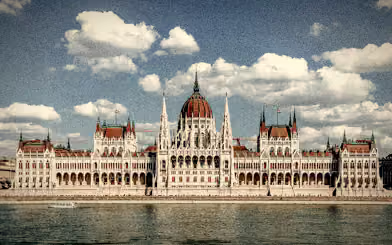
Hungary sought to express its growing independence within the Austro-Hungarian Empire through a new Parliament building. A design competition in 1880 stirred national pride, and the judges selected Imre Steindl’s Neo-Gothic design. Construction began in 1885 and lasted nearly two decades, involving more than 100,000 workers. The building opened in 1902, though work continued for years.
Builders used almost entirely Hungarian materials. The building symbolizes unity and national identity. It was damaged during World War II and the 1956 uprising, then carefully restored. Today, it is both a working government seat and a symbol of Hungarian resilience.
Architectural styles
The design combines several styles. Gothic towers and arches stand out, while the interior has grand Baroque-style halls resembling those of a royal palace. Byzantine art inspired the colorful mosaics and dome decorations. Hungarian folk patterns also appear in the details. This eclectic architecture reflected late 19th-century Hungary’s desire to express its sovereignty, history, and place in European tradition.
What to See Inside the Hungarian Parliament
The Crown Jewels
Displayed beneath the building’s central dome are the Hungarian Crown Jewels, among them the Crown of St. Stephen. They remain under round-the-clock guard and represent Hungary’s thousand-year monarchy.
The Former Upper House Chamber
Legislation is no longer conducted in this chamber, but the former Upper House room remains intact. Visitors can see its wood-paneled walls, ornate ceiling and golden speaker’s podium.
The Holy Staircase
During visits, the king used this ceremonial route, one of several staircases in the building. Stained-glass windows flank the staircase as it climbs toward the dome area.
The Parliamentary Library
Thousands of books are held in the building’s working parliamentary library. A domed reading room and wooden galleries form part of the space.
Notable Features Outside the Hungarian Parliament
Along the Danube
Facing the Danube, the Parliament presents a striking vista when seen from the opposite bank or the Chain Bridge. The facade stretches beside the river, underscoring the building’s scale.
Kossuth Square and the Flag
In front of the Parliament, Kossuth Square displays Hungary’s national flag and serves as a venue for official ceremonies. Locals also gather in this public space, where monuments commemorate important moments in Hungary’s history.
The Building’s Central Dome
Between the two symmetrical wings, the central dome forms the Parliament’s highest point and Budapest’s highest point. It can be seen from far across the city and identifies the building’s central axis.
Tickets for the Hungarian Parliament
Hungarian Parliament Audio Guided Tour
Combo (Save 8%): Hungarian Parliament Guided Tour + Danube River Sightseeing Cruise Tickets
Combo (Save 8%): Hungarian Parliament Multilingual Audio Guided Tour + Széchenyi Spa Entry Tickets
Budapest Grand City Tour with Parliament Visit
What defines Hungarian Parliament Architecture?
Who was the architect of the Hungarian Parliament Building?
Hungarian architect Imre Steindl designed the building after winning a national competition in 1880. He went blind before construction was complete and never saw the finished building.